Biggest Mistakes New Real Estate Investors Make
Avoid costly errors in real estate investing. Learn why overpaying, bad contractors, and weak exits ruin non-owner-occupied investment returns.

Table of Contents
The barrier to entry in real estate investing is deceptively low, but the cost of education is often paid in lost equity and drained bank accounts. For new investors, the excitement of the first deal frequently masks structural risks that can derail a portfolio before it even begins. Success in this industry is built on disciplined underwriting, reliable labor, and a deep understanding of exit liquidity.
This guide is designed for serious investors focusing on non-owner-occupied properties, whether through fix-and-flip strategies or long-term DSCR rentals. We will break down the variables that lead to failure and provide the frameworks used by institutional-grade investors to mitigate those risks.
You will learn how to identify the red flags in a property's financials, how to vet the team building your project, and why your financing strategy is just as important as the physical asset. By the end of this article, you will have a checklist for evaluating your first or next investment with a professional lens.
Overpaying: The Fatal Flaw of Emotional Underwriting
In real estate, you make your money when you buy, not when you sell. New investors often fall into the trap of 'falling in love' with a property and adjusting their financial models to justify an inflated purchase price. They assume that market appreciation will fix a bad buy, but in the world of non-owner-occupied investing, hope is not a strategy.
The 70% Rule and Beyond
Experienced flippers often utilize the 70% Rule: never pay more than 70% of the After Repair Value (ARV) minus the cost of repairs. If a house has an ARV of $400,000 and requires $60,000 in work, your maximum allowable offer (MAO) should be $220,000 ($400k x 0.70 = $280k; $280k - $60k = $220k). Paying $250,000 in this scenario doesn't just cut into profit; it eliminates your safety margin for unforeseen holding costs or market corrections.
Common mistakes when calculating value include:
- Using active listings rather than sold comparables for ARV.
- Failing to account for property-specific drawbacks like proximity to highways or power lines.
- Ignoring seasonal market fluctuations that impact days-on-market.
- Underestimating transaction costs, including title insurance, transfer taxes, and commissions.
Contractor Mismanagement and Budget Creep
Your contractor can be your greatest asset or your biggest liability. Many new investors hire the lowest bidder without checking references or verifying licenses. This often leads to 'change order' culture, where the contractor continually asks for more capital to finish the work they already agreed to do.
Never pay a contractor more than a small mobilization deposit upfront. Tie all subsequent payments to specific, verifiable milestones like 'Rough-in plumbing complete' or 'Drywall finished and sanded.' This keeps the project moving and ensures you never pay for work that hasn't been performed.
A common mistake is failing to build a 15-20% contingency into the renovation budget. On a $50,000 renovation, you should have $7,500 to $10,000 in reserve specifically for 'behind the wall' surprises like outdated wiring or structural rot. Without this, a single unexpected issue can freeze your project and lead to expensive loan extensions.
The Danger of Thin Cash Reserves
Real estate is a capital-intensive business. New investors often exhaust their liquid cash on the down payment and initial repair costs, leaving nothing for the 'holding' phase. Holding costs include interest payments, insurance premiums, property taxes, and utility bills—all of which accrue even if the project is stalled.
For a bridge loan or fix-and-flip loan, you must account for monthly interest-only payments. If your project takes nine months instead of six, those extra three months of interest can be the difference between a $30,000 profit and breaking even.
Liquidity Requirements
Lenders typically want to see that you have several months of 'interest reserves' in the bank after closing. For rental properties (DSCR loans), having a cash reserve helps you weather vacancies or major repairs like a HVAC failure ($6,000+) or a new roof ($12,000+). Over-leveraging yourself to the point of zero liquidity is the fastest way to lose a property to foreclosure.
Underestimating Financing Costs and Speed
New investors often treat investment property financing like a primary residence mortgage. This is a mistake. Financing for non-owner-occupied properties—whether for a fix-and-flip or a long-term rental—is based on the asset's performance and the investor's experience, not just a personal debt-to-income ratio.
Ignoring the nuances of leverage can lead to:
- Choosing the wrong loan product (e.g., using a high-interest bridge loan for a property you intend to hold for 5 years).
- Failing to account for 'points' and origination fees in the total project cost.
- Missing out on a deal because your lender couldn't close within 10-14 days.
- Not understanding prepayment penalties on DSCR loans.
Speed is often more valuable than the interest rate. In a competitive market, being able to provide a Proof of Funds and close quickly via a private lender allows you to secure properties at a discount that more than offsets a slightly higher interest rate.
Weak Exit Strategies and Market Blindness
An investment without an exit strategy is just a liability. Professional investors always have a Plan A, Plan B, and Plan C. If your 'Plan A' is to flip the house but the market cools, do you have a 'Plan B' to refinance into a long-term DSCR loan and rent it out? If so, does the rental income cover the new debt service?
- Assess the Debt Service Coverage Ratio (DSCR): Ensure the property rents for at least 1.2x the monthly mortgage, taxes, and insurance.
- Analyze Local Vacancy Rates: A 10% vacancy rate in a submarket can kill your cash flow.
- Understand Buyer Demographics: If you are building a $600,000 house in an area where the median income supports a $350,000 house, your exit will be slow and painful.
The worst time to figure out how you're going to get out of a deal is after you've already bought it.
Ignoring the 'Non-Owner-Occupied' Regulatory Landscape
Financing for investment properties is federally and state-regulated differently than consumer mortgages. Investors must understand that their properties are business assets. Using a residential 'owner-occupied' loan for an investment property is mortgage fraud and carries severe legal consequences.
By focusing strictly on investment-purpose loans, you gain access to terms and structures designed for business growth, such as the ability to close in an LLC. This protects your personal assets and allows for more aggressive scaling of your portfolio.
Real-World Example
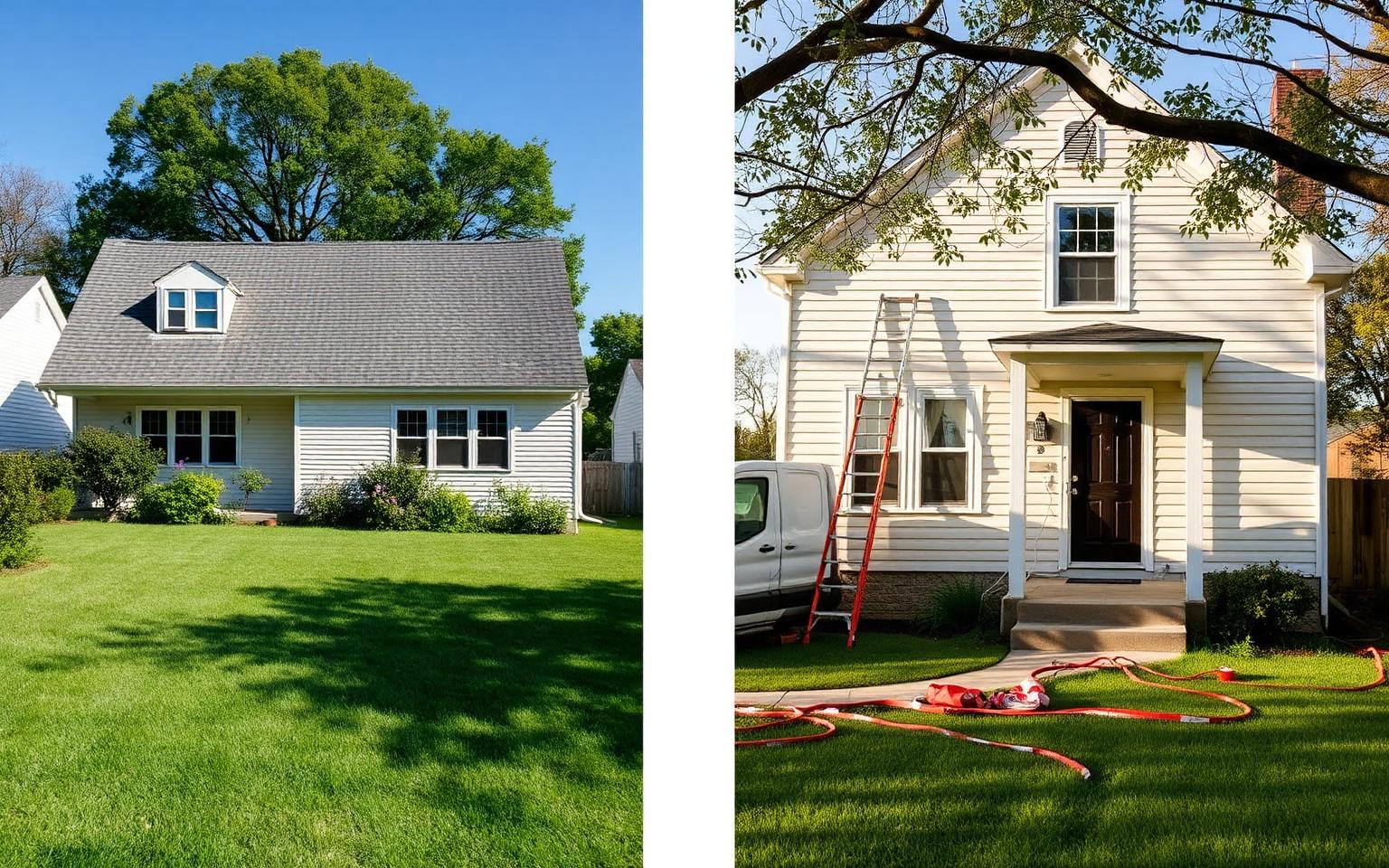
An investor in Charlotte, NC purchased a distressed property for $180,000, projecting a $50,000 renovation and a $320,000 ARV. They failed to get a fixed-price contract and hired a 'handyman' to manage the project. Three months in, the contractor disappeared with a $15,000 draw, and inspections revealed unpermitted electrical work that had to be ripped out.
The final renovation cost swelled to $85,000. Meanwhile, the investor didn't account for the $2,200 monthly interest payment on their bridge loan. Because the project took 10 months instead of five, they paid an additional $11,000 in interest alone. They eventually sold for $310,000. After commissions ($18,600), closing costs ($4,000), interest ($22,000), and the $85,000 rehab, they lost roughly $500 on a deal where they expected to make $40,000. This is a classic example of how bad contracting and high holding costs erode thin margins.
For illustration only — subject to underwriting.
Common Mistakes To Avoid
- 1.Overestimating North-of-Market After Repair Values (ARV).
- 2.Hiring contractors without verified references and insurance.
- 3.Failing to maintain a 15% contingency fund for renovations.
- 4.Using consumer-grade financing for business-purpose investments.
- 5.Ignoring the 'Plan B' rental exit for a failed flip.
Advanced Tips
- Always close properties in a dedicated LLC to isolate liability.
- Master the BRRRR method (Buy, Rehab, Rent, Refinance, Repeat) to recycle capital.
- Build a 'Power Team' consisting of a reliable GC, a specialized real estate agent, and a fast private lender.
- Conduct a 'Pre-Mortem' analysis: imagine the project failed and list exactly why it happened before you buy.
- Use DSCR loans to scale your portfolio without hitting personal DTI limits.
How Simple Solution Lending Helps
At Simple Solution Lending, we provide the specialized capital necessary for successful real estate investing. We focus exclusively on non-owner-occupied investment properties, offering bridge loans for fix-and-flips, new construction financing for builders, and DSCR rental loans for long-term wealth building. We understand that in the investment world, time is money; our streamlined process is designed to get you the leverage you need without the red tape of traditional banks.
Whether you are acquiring a distressed asset for a quick turnaround or refinancing a stabilized multi-family property, our loan products are tailored to the specific needs of the US-based investor. We evaluate deals based on their profit potential and the property's ability to generate income. Ready to secure your next deal? Apply Now or contact our team for a pre-qualification letter to make your offer stand out.
Conclusion
Real estate investing is a game of margins, discipline, and professionals. Avoiding these common mistakes—overpaying, mismanaging contractors, and neglecting liquidity—will put you ahead of 90% of the people entering the market today.
Treat your investments like a business, use the right leverage, and always keep your exit strategy in focus. Success isn't about the one 'big' deal; it's about making smart, repeatable decisions that compound over time.
Frequently Asked Questions
Disclaimer. Loan programs, rates, terms, leverage, and approvals are subject to underwriting, borrower qualification, property type, state availability, and program guidelines. This is not a commitment to lend.